
Can Francesca Hong Win? Yes. Is She the Most Electable? Probably Not.
Here's what the data says.

Democrats have been debating electability all summer. It started with Abdul El-Sayed in Michigan. Many Democrats, particularly those attached to the Democratic establishment, believed El-Sayed was less electable than Haley Stevens. El-Sayed went on to win that primary narrowly on August 4th — worth keeping in mind as you read what follows. With that contest in the rear-view mirror, the electability debate has moved to Wisconsin, where DSA member Francesca Hong is running for governor and leading in the polls.
Lots of people in Wisconsin and in the national Democratic Party are in a panic about Hong’s electability. When she began to surge in the polls, the Democratic Party establishment, led by the governor, encouraged the other candidates to drop out and consolidate behind Lieutenant Governor Sara Rodriguez. When Rodriguez was forced to drop out amid a campaign-finance shortfall, Milwaukee County Executive David Crowley got back in the race and got the immediate endorsement of the governor. Many national Democrats are aghast at the possibility of Hong becoming the nominee, particularly after she gave several answers that weren’t particularly confidence-inspiring about tweets from a few years ago that talked about defunding the police and canceling Thanksgiving.
Jon Favreau and I talked about this race and Hong’s electability on Friday’s episode of Pod Save America. And I have been thinking about my answer for the last few days. I knew it in the moment, but I whiffed. I kinda, sorta didn’t take a strong position.
I hate these electability debates, particularly since 2024. I think all of us need to have a little more humility after Trump won a second term after inciting an insurrection and being convicted as a felon for paying off a porn star to conceal an extramarital affair. I have also had a visceral reaction to the debates around El-Sayed and Hong, because people said the same thing about Barack Obama. In fact, many of the people saying El-Sayed and Hong can’t win are the SAME people who claimed Obama couldn’t win.
Just because electability is an inherently unknowable concept, that doesn’t mean we can’t use experience and data to make assessments about which candidates give us the best shot in purple and red states. Here’s my take on that race:
Can Hong Win?
Yes.
Wisconsin is a 50-50 state, so much so that it has been decided by less than a point in 5 of the last 7 presidential elections. This year is shaping up to be several points more Democratic than it was in 2024, when Trump won the state by less than a point — the national environment and the generic ballot both point that way, though how much of that materializes in Wisconsin is a guess, not a given.
In Michigan, it’s fair to say Mike Rogers is an average Republican candidate — he actually underperformed Trump in 2024, losing his Senate race while Trump carried the state. Tom Tiffany, the Republican in Wisconsin, is a MAGA-aligned candidate without broad crossover appeal. He is very beatable.
None of this is to say it will be easy for Hong, if she is the nominee. Far from it. Hong would also be running to succeed a two-term governor from her own party, and that is always challenging — especially when voters are in a sour mood like they are this year.
Is Hong Less Electable than Crowley?
There are a few ways we can assess potential electability. None of these are perfect, and some are much more art than science.
The first, and best, measure is previous electoral performance. Do they have a history of winning tough races, persuading swing voters, or overperforming the political environment? Split Ticket uses a Wins Above Replacement measure to quantify the best electoral performers. Neither Hong nor Crowley has run statewide before, and they both represent very Democratic areas. Madison, which Hong represents, is one of the more liberal cities in the country. Kamala Harris won the city of Madison by 67 points, making it more Democratic than the districts DSA candidates won in New York and Colorado earlier this cycle.
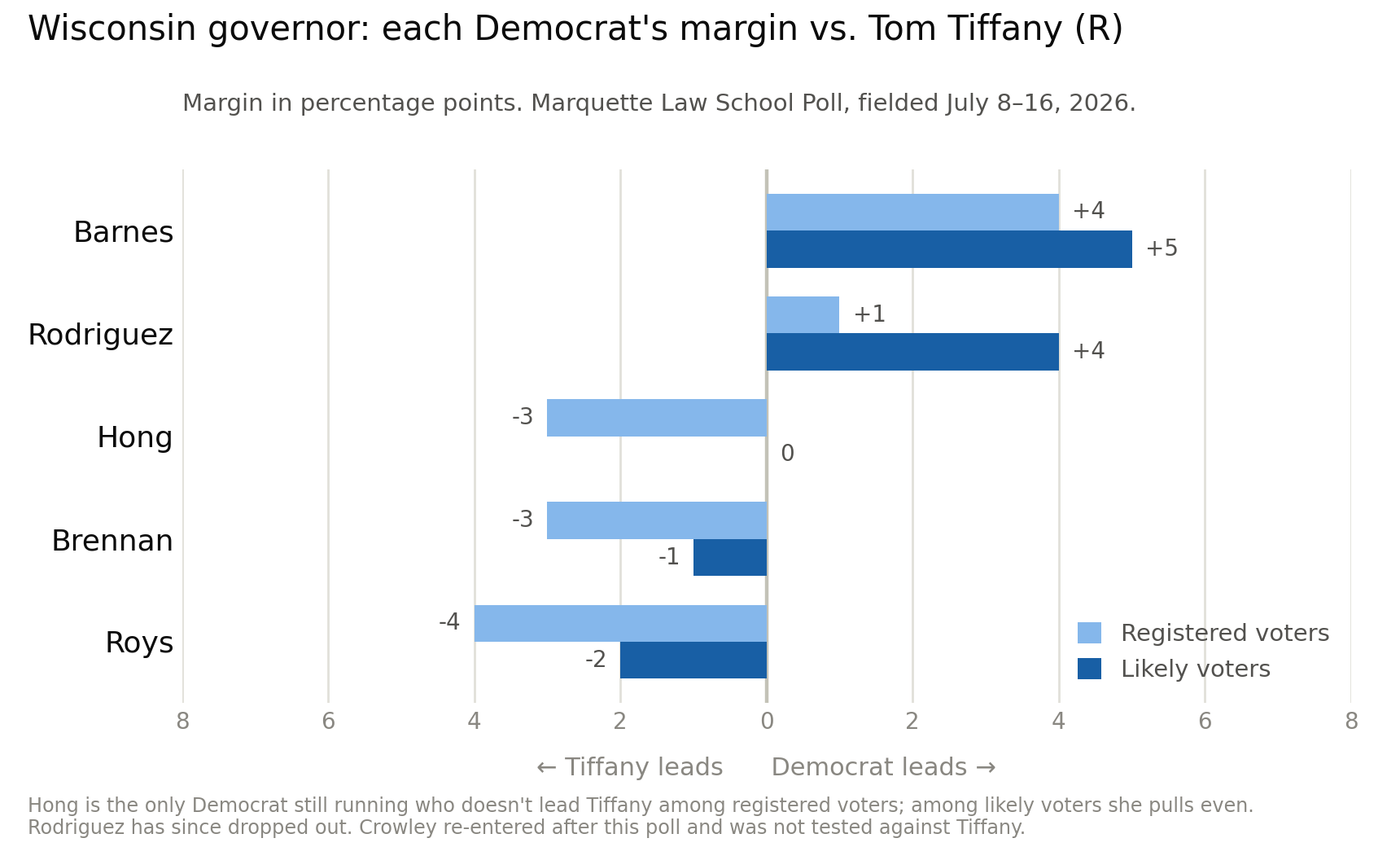
Another way to assess electability is to use hypothetical polling matchups. In a Marquette poll from July, Hong trailed Tiffany by 3 among registered voters and among likely voters, a more Democratic-leaning sample; the race was tied. Crowley wasn’t tested because his campaign was suspended when the poll was in the field.
We can also look at whether a candidate is ideologically aligned with the electorate. This is not a perfect measure, on two fronts. First, there are plenty of examples of states and districts electing people to the left or right of the median voter. Second, perceived ideology matters more than actual ideology. I know this will make you want to bang your head against the nearest hard surface, but Kamala Harris was perceived as more extreme than Trump.
Crowley is ideologically aligned with Governor Evers, who won statewide twice. Hong is to the left of Crowley and Evers, and she is decidedly more liberal than the overall electorate in a state Trump won twice.
For Hong, that positioning is embodied by her membership in the Democratic Socialists of America. In Wisconsin, the DSA as an organization is about 18 points underwater with voters. This seems bad, until you notice the Democratic Party itself is 23 points underwater. In other words, the socialist brand is no worse than the party label every Democrat already carries (womp!). The bare “democratic socialist” label does fare worse, at roughly −30, but the org-to-org comparison is the fair one.
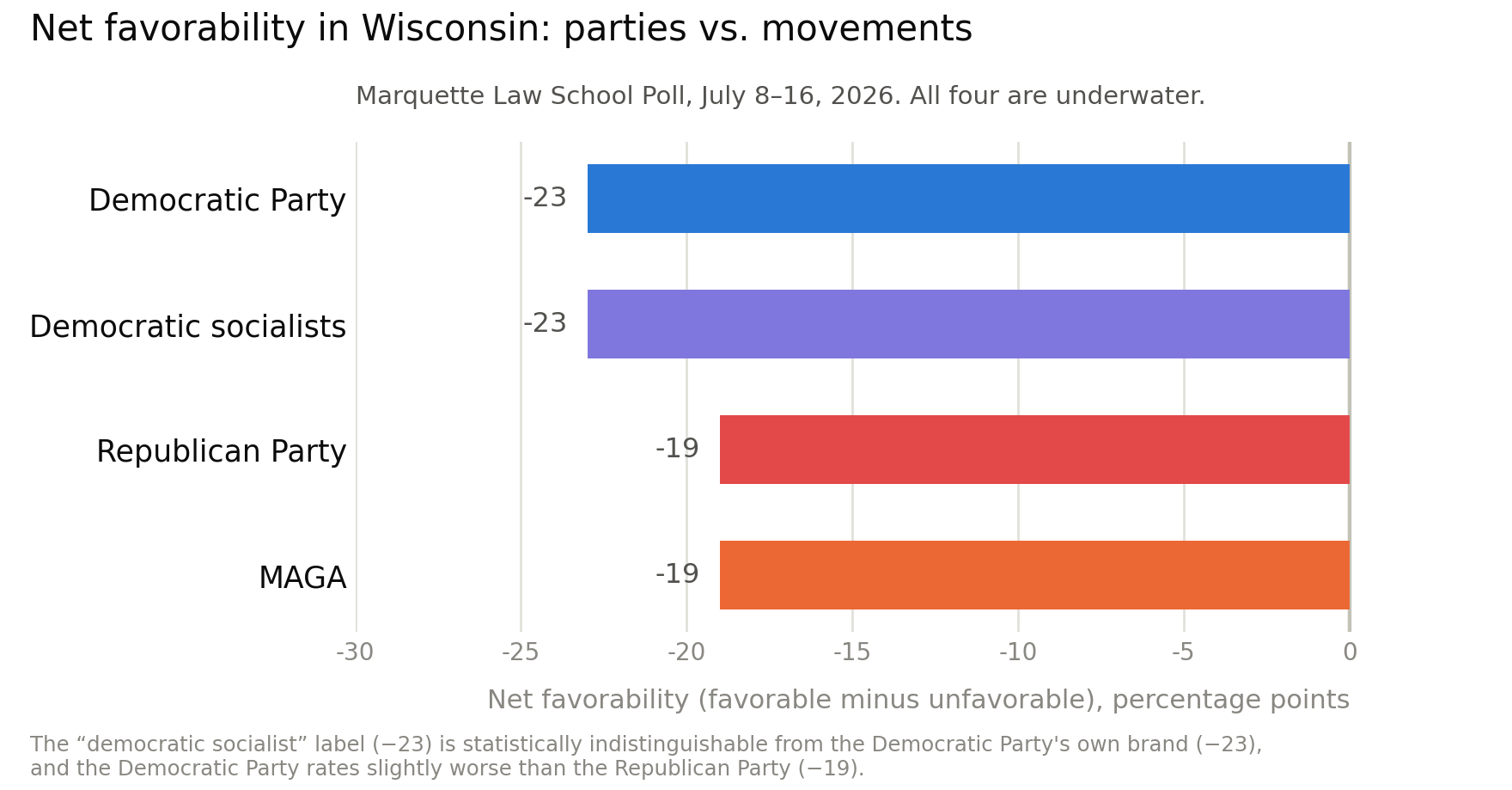
You could look at this and say: see, there’s no real difference between nominating Hong, Crowley, or any other Democrat. But it’s not that simple. A majority of independent voters (52%) have an unfavorable opinion of the DSA, and there is national polling showing about half of voters say they’re less likely to back a democratic socialist candidate.
While I disagree with lots of their platform, I want the Democrats to have a very big tent, and that tent can include the DSA. It should be big enough to include AOC and Mary Peltola and anyone else who wants to fight for working people, stand up to fascism, and make this country more fair and just. But I think it is very clear that running as a Democratic Socialist in a state like Wisconsin is a significant brick on the load.
What It All Means
What makes this hard is that the establishment or moderate wing has not given voters a particularly compelling alternative. I interviewed David Crowley on Pod Save America. He seems like a good, smart, results-oriented public servant. But he is the very clear choice of the establishment at a time when people are furious at the establishment. Hong is offering big, bold change; Crowley is focused on improvements to the status quo. Think of his message as continuity-plus.
Data centers are a huge issue in Wisconsin. In the Marquette poll, 76% of Wisconsin registered voters said the costs of data centers outweigh the benefits, up sharply from 55% in October 2025. Hong is for a moratorium, and Crowley isn’t,
But Crowley doesn’t have the socialist label. He doesn’t have a bunch of since-deleted tweets that can be weaponized against him. And if you had to ask me today which candidate is more likely to win in November, I would have to say David Crowley.
That may seem intuitively obvious to some on Twitter. But many of the people saying Hong can’t win are the same people who said Hillary Clinton couldn’t lose and that Joe Biden should run for reelection. So I get why Wisconsinites are skeptical of the advice from the peanut gallery. This is up to the voters of Wisconsin to choose, and I don’t envy the choice.
I don’t want people to walk away from a candidate who inspires them or gives them hope in a very dark time just because some pundits said they weren’t electable. But I wanted to lay out the facts and the data before people go to the polls.
Very interesting. I have not been following Wisconsin since I am in Minnesota. The only thing I can add is that, if other voters are anything like me, they are angry. Very angry. At Republicans and Democrats, but particularly at those in government who have put themselves and their own self-interest before the people who elected them. We are voting as a means of shouting at our party what we want and where we stand. It's time for our party leaders to listen, not tell.
What is that thing we say here in America about letting the voters choose? Maybe the Dem party needs to stop mansplaining to voters what we want and listen to what we actually want. DSA members are articulating a clear vision for the country while mainstream Dems are not. They are saying the things Americans want to hear and painting a picture we can envision. It’s compelling in the same way the tea party and maga were/are. Also, not for nothing, Dems have been bemoaning their inability to get traction in the media. DSA candidates are getting to explain their vision and defend their views because they’re getting the airtime to do it in a way that the mainstream dems aren’t/havent. And their message is hitting in all the right ways. If the Dems who have been steering the ship toward the iceberg for the past several years would just shut up for a second maybe they would realize that instead of beating DSA candidates, they might want to join them. Also, PS who wouldn’t have wanted to see a Harris/Walz campaign that didn’t go all tepid and tamped down the second establishment dem operatives (looking at you, Plouffe) got involved? I haven’t been this energized/excited by candidates since Obama. That means something.