
Democrats Now Have a Path to a Senate Majority
A top notch candiate in Alaska givens Dems a shot at taking the Senate

Democrats got some much-needed good news yesterday—and it came from Alaska of all places.
Former Congresswoman Mary Peltola announced her candidacy for the Senate. Senator Schumer has been recruiting Peltola for months, and her decision to throw her hat in the ring gives Democrats a plausible candidate against Republican Dan Sullivan.
While Democrats have a clear (though not easy) path to winning the House, a Senate majority has seemed out of reach for much of the past year. But through a series of recruiting coups, Republicans opting out of key races, and Donald Trump’s deteriorating political position, a path has emerged. Peltola’s decision is the final piece of that puzzle. Democrats now have a real shot at the Senate.
Here’s why.
***It’s an election year. I’ll be covering the midterms to help you understand the political forces shaping the race—and how you can make a difference, from which campaigns to support to how to talk to friends and family about voting Democratic. Subscribe to get every post delivered to your inbox***
The Senate is currently 53–47. To take the majority, Democrats need a net gain of four seats. We need to get to 51 because Vice President Vance breaks ties in a 50–50 Senate.
There are three parts to the path to winning the Senate.
Part One: Defending Our Territory
If Democrats want a Senate majority, we cannot afford to lose any currently Democratic-held seats. Four of those seats are in play.
Georgia: Popular Governor Brian Kemp decided not to run against Jon Ossoff. Instead, three candidates are vying for the GOP nomination: two mediocre MAGA congressmen and a former college football coach. In a state as close as Georgia, anyone can win, but Ossoff would likely be a slight favorite against any of them.
New Hampshire: Jeanne Shaheen is retiring, and Representative Chris Pappas is the favorite in the Democratic primary. Once again, a popular(ish) GOP governor took a pass on running for Senate. Instead, the Republicans have Sununu’s father and former Massachusetts senator Scott Brown. Pappas would be a favorite in a state Harris won by about three points.
Michigan: There is a vigorous Democratic primary with three compelling candidates battling for the chance to run against former Representative Mike Rogers, who nearly beat Elissa Slotkin in 2022.
Minnesota: Like Michigan, Minnesota has a competitive Democratic primary with two strong candidates. Unlike Michigan, there is no obvious Republican contender.
Part Two: The Must-Win Toss-Up States
Once we hold our territory, there are two must-win states.
Maine: Susan Collins is up for reelection, and she is the last Republican senator in a reliably blue state. Kamala Harris won Maine by seven points. Collins is hard to beat—she won by seven in 2020 while Biden won the state by nine. I’ve written extensively about the contentious primary between Governor Janet Mills and oysterman Graham Platner. We can debate which Democrat has the better chance of beating Collins until the cows come home (and probably will). Either way, Collins has to be beaten.
North Carolina: Democrats haven’t won a statewide federal race in North Carolina since 2008. In most years, this would be a stretch. But this year, Roy Cooper—the very popular former governor—is running. Cooper won twice while Trump was winning the state. With him on the ballot, Democrats have a very real shot.
Part Three: The Stretch States
If Democrats hold their seats and win North Carolina and Maine (no small task), they are still two seats short of a majority. That means winning two of these four very red states.
Ohio: Ohio has gone from a prototypical toss-up to a solidly red state in the Trump era. It’s only on this list because former Senator Sherrod Brown is running. Trump won Ohio by 11 points in 2024, while Brown lost by about 3.5—an overperformance of seven points. That bodes well in what should be a much more favorable political environment this fall.
Iowa: Iowa is another red state, but one that has been hit hard by Trump’s policies. Farmers are being hammered by tariffs. Rural hospitals face closure due to Medicaid cuts. The likely GOP nominee is a congresswoman who has repeatedly sided with Trump over Iowa’s interests. Democrats have several interesting candidates. If one emerges with a compelling message and generates excitement, the state could be in play.
Texas: Democrats have been eyeing Texas for more than a decade. It was once believed the state turning blue was a matter of when, not if. But it has gotten redder under Trump. This year could be different. Republicans face a nasty three-way primary that could knock out incumbent John Cornyn. If Ken Paxton wins, either James Talarico or Jasmine Crockett would have a real shot.
And then there’s Alaska.
Northern Exposure
It sounds crazy to say Democrats can win Alaska—but Mary Peltola is not a typical Democrat. She won a special election in 2022 and then a full term later that year. Alaska has only one member of Congress, so Peltola already has statewide name recognition, blunting the usual advantage of an incumbent senator.
She has cultivated a non-partisan persona, explicitly modeling herself after Alaska Republican stalwarts like Ted Stevens and Don Young, whom she replaced in Congress. Her announcement video message is simple: fish, family, and freedom.
And the polls suggest this race is winnable. A Data for Progress poll shows Peltola is seven points more popular than Trump and eight points more popular than Sullivan in Alaska—and that the race itself is essentially a dead heat.
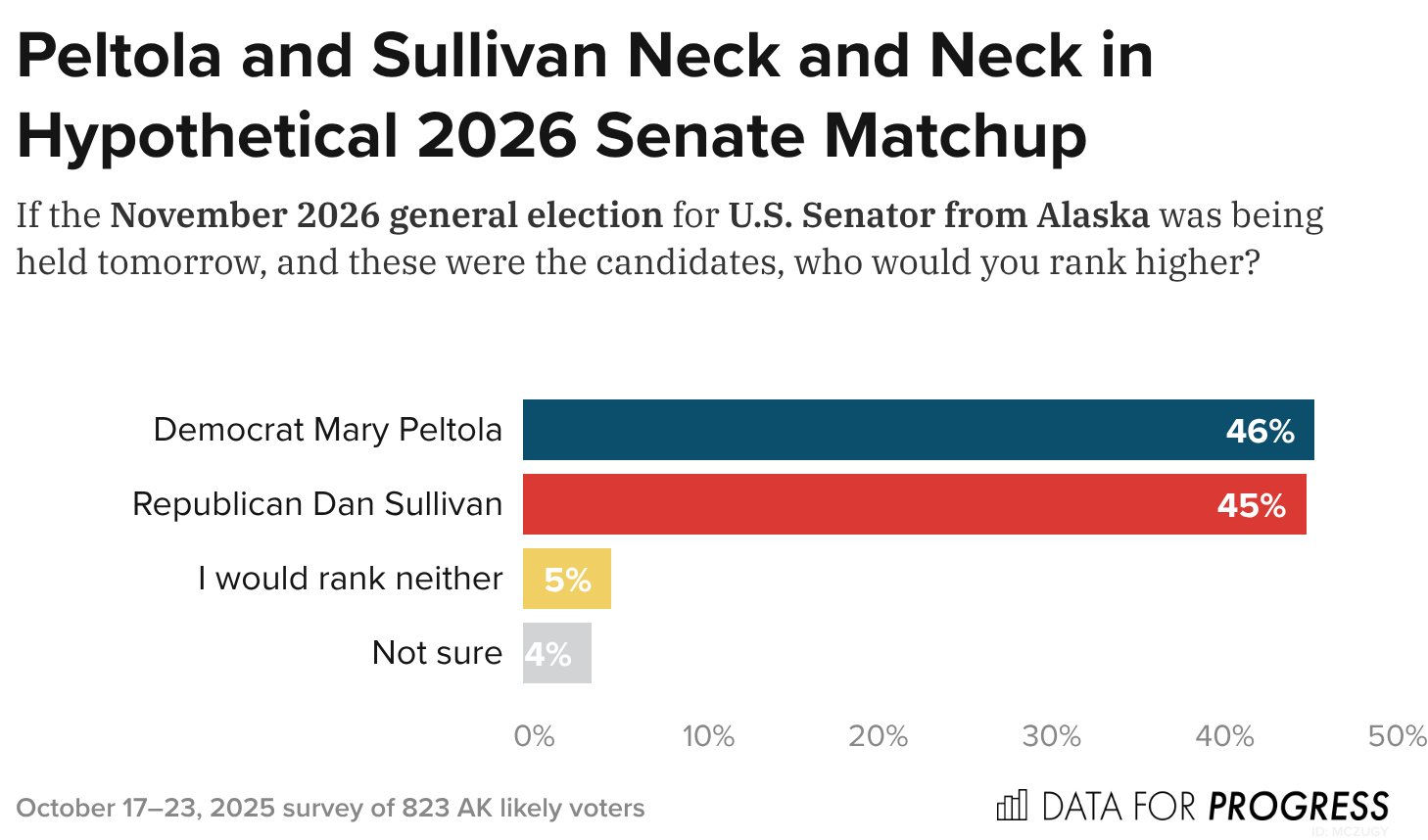
Mary Peltola gives Democrats a legitimate shot in Alaska. And that means Democrats have a legitimate shot at the Senate.
Former Governor Chris Sununu's father, John W. Sununu is not running (he's 86). Chris's older brother, former Senator John E. Sununu is running.
Great piece, Dan. Thanks for sharing the Peltola video. Very compelling and I will be donating to her campaign.