
The Complicated Politics of Medicare for All
A thoughtful new poll cuts through years of motivated polling — and complicates the story both the left and the center like to tell.

The other day, a clip of Georgia Senator and potential Democratic savior Jon Ossoff, from a 2020 interview with Axios, began circulating online.
In the interview, Ossoff says he opposed Medicare for All. This led to a lot of bashing and consternation from progressive Democratic activists online.
Many of them demanded to know how Ossoff could possibly oppose Medicare for All. It is an article of faith on the left that Medicare for All is an incredibly popular policy, and that the only reason more Democrats don’t support it is that they’re doing the bidding of corporate donors.
Medicare for All, which had been on the political backburner since Biden won the 2020 primaries, has reemerged as a major issue this cycle. The three victorious progressive candidates in New York City were Medicare for All supporters. Melat Kiros, who upset a 30-year incumbent in Colorado, was a supporter, as were Chris Rabb, Randy Villegas, and Matt Dunlap, who all defeated establishment-backed candidates in their primaries.
On the Senate side, Juliana Stratton won the Illinois primary in part by running on Medicare for All, and Abdul El-Sayed, who literally wrote a book on the policy, made it a centerpiece of his campaign. Graham Platner did the same, before he was forced to withdraw from the race.
The reemergence of Medicare for All as a rallying cry for some Democrats matters this fall, and it’s going to have big implications for the 2028 primary.
The politics of Medicare for All have been hard to analyze, because there has been a real lack of quality polling on the issue. Almost all of the publicly available data has come from progressive advocacy organizations that support it or industry-funded think tanks that oppose it. Question wording matters a lot in any poll, and that’s particularly true for a policy as complex as this one. Even a mediocre pollster can write a question to generate the result they want.
That’s what makes a recent poll, conducted jointly by the Searchlight Institute, a moderate think tank, and Zeteo, a progressive publication, so valuable. It just dropped, and it’s one of the more comprehensive and thoughtful surveys I’ve seen in a long time.
Just to lay my cards on the table: I come to this as someone who strongly supports Medicare for All, or a similar single-payer program, and believes it’s something Democrats should work toward, because I believe health care is a human right. But as someone who went through the absolutely brutal process of passing the Affordable Care Act with historically large Democratic majorities, I’m also wide-eyed about the political and legislative pitfalls of enacting this policy anytime soon.
The debate around Medicare for All, on both sides, is so often detached from political reality that it becomes counterproductive to enacting the best possible health care policy.
This is a reader-supported newsletter. Every paid subscription makes it possible; I hope you will consider signing up.
Why M4A Can Be So Powerful
Medicare for All has been incredibly powerful in the context of Democratic primaries for a few reasons.
First, Democrats strongly support universal health care. A 2025 Pew poll found that 90% of Democrats believe the government should provide health insurance for everyone. This finding is consistent with a raft of other polling over the years.
Second, Medicare for All is the best-branded Democratic policy in decades. Everyone loves Medicare, so it’s a very appealing alternative to the current system, particularly for Democrats.
Finally, Democrats are in the mood for big solutions to the health care crisis. They are instinctively skeptical of what appear to be small-bore fixes. In the NYT/Siena poll from earlier this summer, Democratic voters wanted the party to move to the center on crime and immigration and were split on where the party should go on the economy. Health care was the only issue where Democrats wanted the party to move left, and they preferred moving left over tacking to the center by 25 points.
More than the polling numbers, support for Medicare for All signals something bigger than health care. It’s a sign that a politician gets the scale of the affordability crisis and is willing to take on powerful corporate interests — in other words, the opposite of what so many Democrats currently believe about their own party.
A Tougher Issue in the General Election
When you test the phrase “Medicare for All,” it tests quite well. A 2025 Kaiser Family Foundation poll (the gold standard in health care polling) found:
Medicare-for-all starts with a net favorability rating of +14 percentage points (56% favor it, 42% oppose it). This jumps to +45 percentage points when people hear the argument that this type of plan would guarantee health insurance as a right for all Americans.
Seems great, right? It is, but it gets more complicated as you dig deeper.
The Zeteo/Searchlight poll found that support depended heavily on how the program was described. The most effective description was:
Automatically enrolling every American in a comprehensive government-administered health insurance plan, something like the Medicare coverage that people 65 and older get.
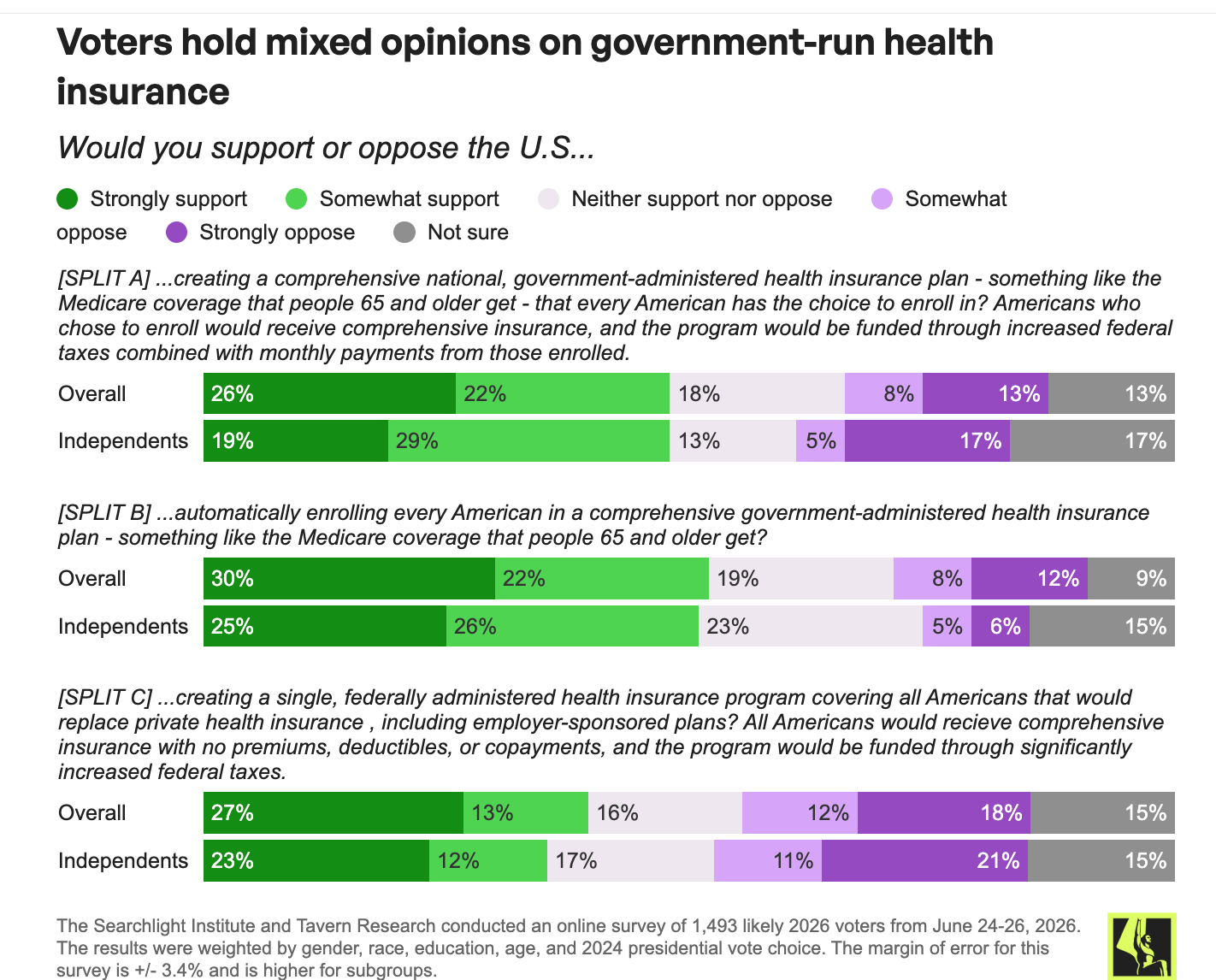
Support drops significantly, unsurprisingly, when people are told that M4A would involve replacing private health insurance.
If people think the health care system is in crisis, hate insurance companies, and like Medicare, why does support drop?
The first problem is that only 29% of people said they’re confident the federal government could successfully administer a national insurance plan. I suspect that number would rise some among Democrats with a Democrat in the White House, but distrust in government is a significant and longstanding barrier to large government-run programs.
To put this in context: when LBJ was passing Medicare, 77% of Americans trusted the federal government, according to Pew polling.
The second problem is that people hate the health care system but are much more satisfied with their own health coverage. In this poll, 70% of voters, and even 58% of Democrats, said they would rather stay with their own insurance than switch to a Medicare for All-type plan.
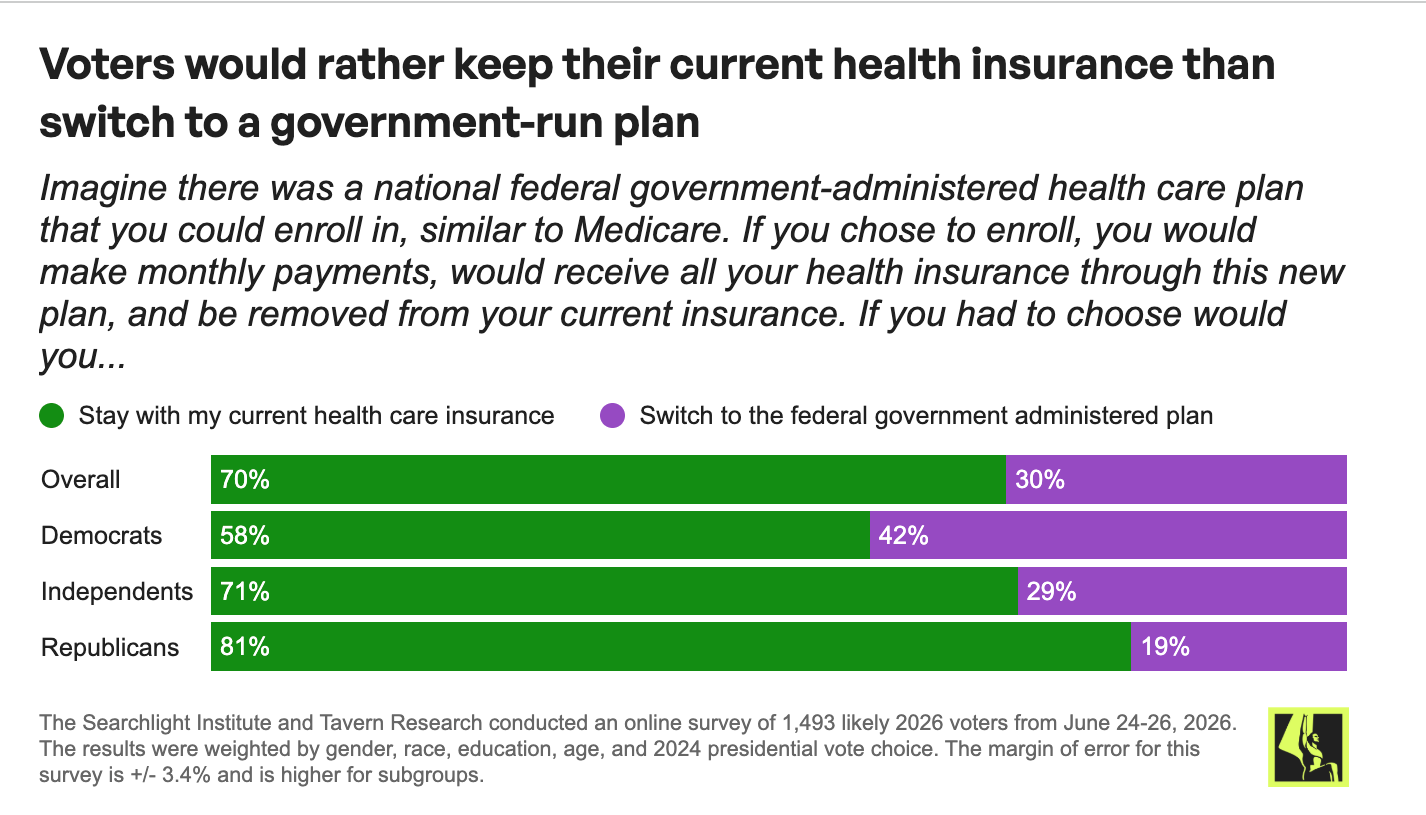
This finding gets at one of the vulnerabilities in how Medicare for All advocates often discuss the policy. It’s frequently framed around providing universal coverage and helping the uninsured. Morally and substantively, that’s the right thing to do, but it’s worth remembering that the vast majority of Americans already have health insurance. It may be too expensive, not cover enough, and generally be terrible, but those people mostly want their health care made cheaper and better, not replaced outright. Health care costs are the biggest issue, and M4A would address those costs — but its advocates need to lead with that in their messaging.
None of this is an argument for Democrats to abandon Medicare for All. Far from it. People who authentically and passionately support it should run on it. More M4A advocates in the House and Senate would be a huge improvement and push the party in a more populist, progressive direction. Nothing here suggests a Medicare for All advocate can’t win a tough race. But if we want to make the policy a reality, Democrats need to win enough seats to make real progress toward its goals, and we can’t do that without first reckoning with the political reality.
Definitions are important here. I believe strongly that healthcare is a human right and I believe in universal healthcare. I remember well the difficulty in getting the ACA passed and volunteered for 2 years to spread the word and help people sign up.
I am a Medicare patient and it is great but it’s not cheap. You still pay a premium for doctor care, it only pays 80% and you must have a secondary plan plus Part D. It’s more expensive than people realize.
I suggest we use the phrase Universal Health Care for All so that folks don’t get confused. I just hope there is a way to get it passed. That means a significant Dem majority
Dan- you leaned heavily on the moral argument of human right. The reality is the the private health care industry is unsustainable as it is currently funded. We spend more than any other country and have worse outcomes. It is breaking the bank for families and the government to subsidize private insurance. I know families that now pay 30 grand a year with the subsidies gone. The questions here are interesting. But still not accurate. The reality would be a mix of private and public. No OECD country eliminates private health insurance. It is not paid for by only taxing the wealthy. But what is does guarantee is never facing medically bankruptcy. That would be a question on a poll. Do you support a government system that would replace most private insurance where you could never face medical bankruptcy due to lack of coverage? The politics of this is the lanes. Do you run one Bernie lane or Chuck Schumer lane. Running in Bernie’s lane is M4A. You can’t waver as it is motivating and taking in power of the rigged system. Abdul is showing as the leading in MI and not moving to the center he can keep his poll numbers up. We will see if this strategy works for winning the primary. Trump has destroyed Obama care. There needs to be something new. The Schumer lane have not offered an alternative that I am aware. You don’t like Abdul’s plan. What is your plan?