
The Texas Primary, Electability, and the Mobilization Myth
The Talarico v. Crockett race has gotten nasty, but the electability debate is about more than the two candidates

In less than a week, Texas Democrats will decide whether James Talarico or Jasmine Crockett will be their nominee for Senate. This is a massively consequential decision because the Lone Star State may be in play this cycle, and Democrats may need it for the majority.
Talarico and Crockett are well-liked, admired figures in the party. Both have been cast as rising stars in a party desperately seeking a brighter future. They are excellent communicators who have built profiles that exceed their political station.
Yet they are now on a collision course in an increasingly nasty primary that threatens to damage the eventual winner and divide the party at a time when we can least afford it. A Super PAC supporting Talarico ran an ad claiming Crockett couldn’t win the general election. Crockett accused the Super PAC of darkening her skin in the ad and called their tactics racist. Crockett then ran an ad asserting that Talarico was cut from the same cloth as Republican Ken Paxton and Trump.

Supporters of each campaign have been squabbling online, with the nastiness increasing by the day.
I’ve really resisted writing about this race because I like both candidates. I have long admired Talarico. Crockett’s communications skills are incredible — something other Democrats should model.
But this discourse has gotten so nasty that dipping one’s toe into it seems genuinely unpleasant. The Texas primary is also a warning about what the 2028 Democratic presidential primary could look like, not to mention the big Senate primaries in Michigan, Maine, and Minnesota. All of these issues are worth examining — for this race and the ones to come.
A Race About Electability
Elections are dynamic exercises in many interconnected and often conflicting issues, but one issue dominates the conversation in the Talarico-Crockett race: electability.
Supporters on both sides are fighting about which candidate has the best chance to become the first Democrat to win a Texas Senate seat in 38 years.
This has really been the dominant issue in Democratic politics since Trump’s 2016 victory. It was the central focus of the 2020 Democratic primary. The idea that Joe Biden had the best chance to beat Donald Trump is ultimately why so many voters set aside their initial hesitation and handed him the nomination.
One problem with the electability debate is that it’s an entirely theoretical and self-actualizing concept — you can’t know if anyone is electable until they win. All winners are electable, and all losers are unelectable. The other problem is that electability is freighted with racial and gender tropes, where it is automatically assumed that a white man is more electable than a woman or a person of color.
Those tropes are certainly present in the Texas race, even if many people are constantly tiptoeing around them.
I cannot and will not answer the question of which candidate has a better shot at winning Texas. No one can answer that with any certainty, and anyone who claims otherwise is full of it. After the last two decades of American politics, everyone needs more humility about what makes someone electable.
Both are talented communicators with a real connection to their supporters, and both have weaknesses — there are no perfect candidates. What would happen under the klieg lights of a statewide race for all the marbles is an unanswerable question.
There is an additional layer to this debate in Texas: each candidate has articulated a very different theory for how to win the state, and the race has become a proxy for a larger fight in the Democratic Party about electoral strategy.
Two Theories of Winning
What makes the Texas race so unusual is that it’s quite rare for two candidates to hold two explicit and contradictory theories of politics.
Talarico’s argument is that he is more electable because he can win over Republicans and Trump voters. His Christian faith is a central part of his identity, and he has gone viral with appearances on Joe Rogan’s podcast and videos of him debating and engaging with conservatives.
When I spoke to Crockett on Pod Save America late last year about her yet-to-be-announced Senate run, she emphasized that she could turn out Democrats who don’t typically vote in Texas. She often refers to Texas not as a Republican state, but a non-voting state — the implication being that there’s a large, untapped well of Democratic voters.
It’s worth noting that this is something of a false choice. To win in a tough state like Texas, you have to do both. It’s just math.
Even so, where you place your emphasis matters because it signals your approach to politics and your theory of governing.
The persuasion vs. mobilization debate playing out in Texas is the same debate Democrats have been having for decades — and with particular intensity since the 2024 election. Did Kamala Harris lose because she took too many “woke” positions in her last run for president, or did she lose because she depressed Democratic turnout by running as a moderate courting Liz Cheney voters?
In 2024, the answer is both and neither. Harris’s 2020 positions — like the one in the infamous They/Them ad — dogged her throughout the campaign. She also took positions on issues like Gaza that depressed her turnout. But the biggest problem was that she was Vice President to a deeply unpopular president at a time of high inflation.
I can’t tell you whether Talarico or Crockett could successfully execute their chosen strategy. Neither has a documented history of winning over substantial Republican voters or generating ahistorical turnout among Democratic voters.
But I do have a view on which strategy is more likely to work.
The Myth of Mobilization
The Mobilization Theory of Politics is frequently pushed by some progressives. The argument is that by being too moderate, the Democratic Party leaves millions of progressive Americans too unenthused to vote — that non-voters are simply waiting for a candidate to speak to their progressive policy desires.
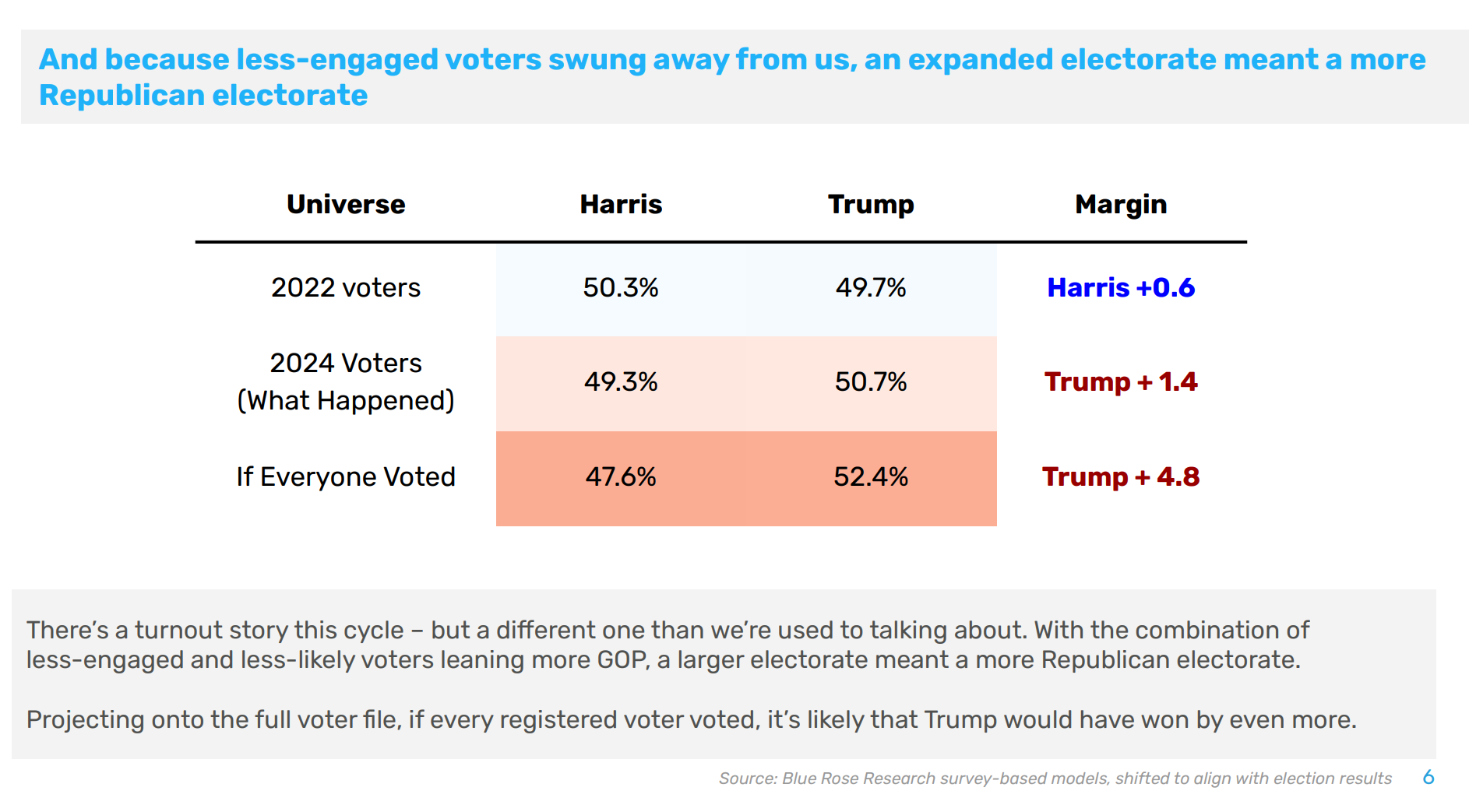
There is little data to support this, at least not in the Trump era. We know that less politically engaged individuals have shifted to the right in recent years. Research from Democratic strategist David Shor shows that if everyone had voted in 2024, Trump would have won by more.
Similarly, the Deciding to Win report examined the ideological preferences of people who didn’t vote in 2024 and found them to be to the right of the median Democrat.
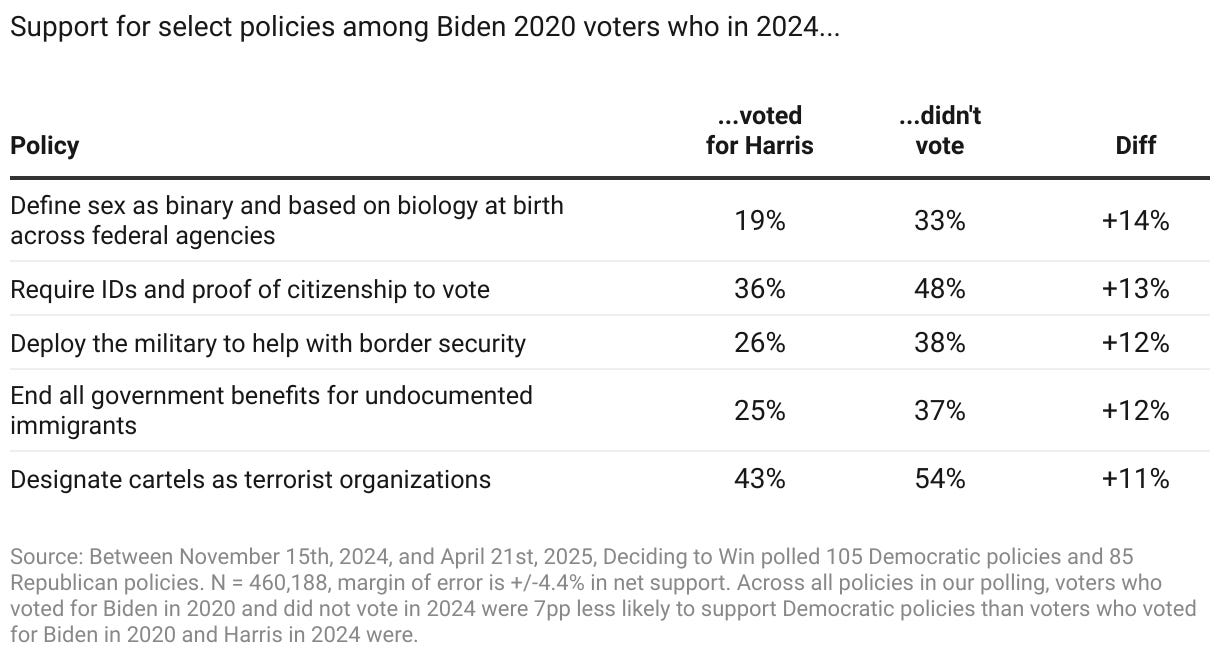
Way to Win, a more progressive organization, has also spent considerable time examining voters who backed Biden in 2020 but sat out 2024, and came to a somewhat different conclusion: these voters are not conservative per se but are inherently less ideological.
There is also the fact that non-voters are more likely to be Black, Latino, and working-class white — all groups that tend to be less progressive than the median Democrat. I’m not arguing they are conservative or even moderate in the traditional sense. Rather, they hold politically heterodox views: many are economically liberal and culturally conservative, or support universal health care while also believing immigration is a problem.
Texas presents a particular challenge. Trump won it by nearly 14 points, a margin powered by huge gains with Latino voters — according to exit polls, he won Texas Latinos by 10 points. There is plenty of polling and electoral evidence that his numbers among Latinos have dropped significantly since then. But even accounting for that shift, a Democrat is going to have to win over a substantial number of Trump voters to prevail statewide. We know it can be done: in Virginia and New Jersey, Abigail Spanberger and Mikie Sherrill each won roughly 7% of Trump voters in 2025.
What’s also notable about the Texas race as a test case for the mobilization vs. persuasion debate is that this is not a contest between a progressive and a moderate. Talarico and Crockett hold essentially the same positions on all major issues. The difference between them is not ideological — it’s temperamental. Talarico emphasizes compromise with those he disagrees with; Crockett highlights her reputation as someone who will take the fight to Trump and Republicans.
The fact that Crockett’s “progressive” credentials center primarily around being more anti-Trump raises real questions about her ability to turn out first-time voters who pay less attention to politics.
What It All Means
I am not arguing for moderation for moderation’s sake. I believe voters are less ideological than we think, and that the true axis of American politics is not left-right but inside-outside. I want Democrats to run economically populist outsiders whose message is broadly appealing enough to expand our coalition. Voters are looking for someone who will take on a broken system, and the candidates who generate outsized turnout and excitement tend to be outsiders: Obama, Trump, AOC, Bernie Sanders.
But the Senate map and the Electoral College are structured in ways that force Democrats to win over some Republicans and Republican-leaning independents. There are only four Republicans currently representing House districts that Kamala Harris won in 2024.
It’s structurally unfair — but politics is often a home game for Republicans. To build a governing majority capable of defeating MAGA over the long run, Democrats need to persuade swing voters and turn out the base. There is no other option. If we thumb our nose at everyone who voted for Trump, we can’t do the former. If we become Republican-lite, we can’t do the latter.
My biggest concern in Texas is that things get so nasty after the election that Humpty Dumpty can't be put back together again. We can only win if we are united. We have two good candidates. Jasmine Crockett is not unelectable, and James Talarico is not the second coming of John Fetterman simply because he reaches out to Republicans.
Whoever wins on March 3rd will need every voter, every dollar, and every ounce of goodwill this primary has left on the table.
This is really helpful, Dan, thank you. (I say that as a former Texan-turned Minnesotan. It’s so hard when there are two excellent candidates, and the intra-party fight is damaging. IYKYK.)
Would you please consider making this one available to share without the paywall? It’s a message a lot of candidates & voters need to hear. Thanks for all your good work. 🙏💙
My guess: Crockett gets the nomination, loses narrowly to Ken Paxton, then she goes on to work for some Democratic PAC or think tank that teaches other Dems how to also lose.