
What Democratic Voters Actually Want
The NYT poll shows that the Left-Right frame is the wrong approach

The 2026 Democratic primary season is in full swing, and it’s mostly being interpreted through an ideological prism — do Democratic voters want the party to move further to the left or tack back to the center? This is a core question in Michigan, Iowa, and several House primaries taking place across the country. It was also the central question in the California race between Tom Steyer and Xavier Becerra. Prospective 2028 candidates and their aides are watching these results carefully, trying to divine clues for what Democrats will want in two years.
The electoral results are interesting and important, but each race is different and shaped by its own circumstances. Did Platner prevail over Mills because of ideology, or was it about age, or something else? In Iowa, the more moderate candidate seems to be leading in the polls — but is he leading because of his moderation, or because he’s been the beneficiary of nearly $10 million in Super PAC ads?
I promise you we’ll all debate these questions based on our priors until the end of time. But the recent New York Times poll has some really interesting data that sheds light on them.
And guess what? It’s more complicated than the pundits and partisans are willing to admit.
What you’re about to read is an excerpt from a detailed strategy memo I wrote for Message Box Pro, my subscription product for people who work in politics or communications at any level.
I’m offering Message Box subscribers a special deal: sign up and your first month is free. After that, you’ll be charged $65/month for full access — but only if you stay. Cancel anytime, no questions asked.
1. Democrats Are Unhappy With Their Party
There has been so much discussion about how bad the Democratic Party’s approval rating has been since Trump won in 2024. We’ve definitely suffered among independents, but the thing driving down Democratic approval is that Democrats themselves hate the party.
In this poll, 53% of Democrats and Dem-leaning independents are unsatisfied with the Democratic Party. The dissatisfaction is greatest among the most important parts of our coalition:
Black voters: 59% dissatisfied
Voters under 30: 68% dissatisfied
Dem-leaning independents: 65% dissatisfied
Even a majority of college-educated white voters are dissatisfied with the Democratic Party. Relatedly, Chuck Schumer is more disliked than liked.
2. A Complicated Ideological Picture
Many political observers have interpreted Democrats’ dissatisfaction with their own party through an ideological frame — that the party is too far left, or not left enough. This poll contradicts that interpretation.
Only 20% say the party is too far to the left, and only 17% say it’s too far to the right. Fifty-five percent say the party is neither too left nor too right.
Based on focus groups, anecdotal data, and common sense, it seems like people are pissed at the party for losing the 2024 election and not doing a better job of standing up to Trump. This is why Democrats are simultaneously telling pollsters that their party sucks and then voting for that same party at every opportunity like their lives depend on it (and they may).
That said, 47% of Democrats and Dem-leaning independents would like to see the party move to the center, while 28% would like to see the party move left and 19% don’t want it to move either way.
And in case you think this result is driven by the inclusion of Dem-leaning independents in the sample, every cohort other than voters under 30 thinks the party should move to the center — and even that group is only a 7-point margin in the other direction. Black and Latino voters want the party to move to the center by very large margins.
The poll also asked voters whether they personally wanted to see the party move left or to the center on a battery of issues. By large margins, Democrats and Dem-leaning independents want the party to moderate on crime and immigration.
3. Electability and Ideology
The poll also asked Democrats and Dem-leaning independents about what the party needs to do to win. I usually hate these sorts of poll questions — I’m much more interested in what voters actually believe than in questions that turn them into pundits and make-believe strategists. But given how heavily Democrats are factoring electability into their choices, this data is pretty instructive.
First, the pollsters asked whether moving to the center, the left, or neither would give Democrats the best chance to win the next presidential election. Consistent with the other results, 52% said moving to the center would help a Democrat win, while only 25% said moving to the left would.
A similar dynamic exists across all issues except health care.
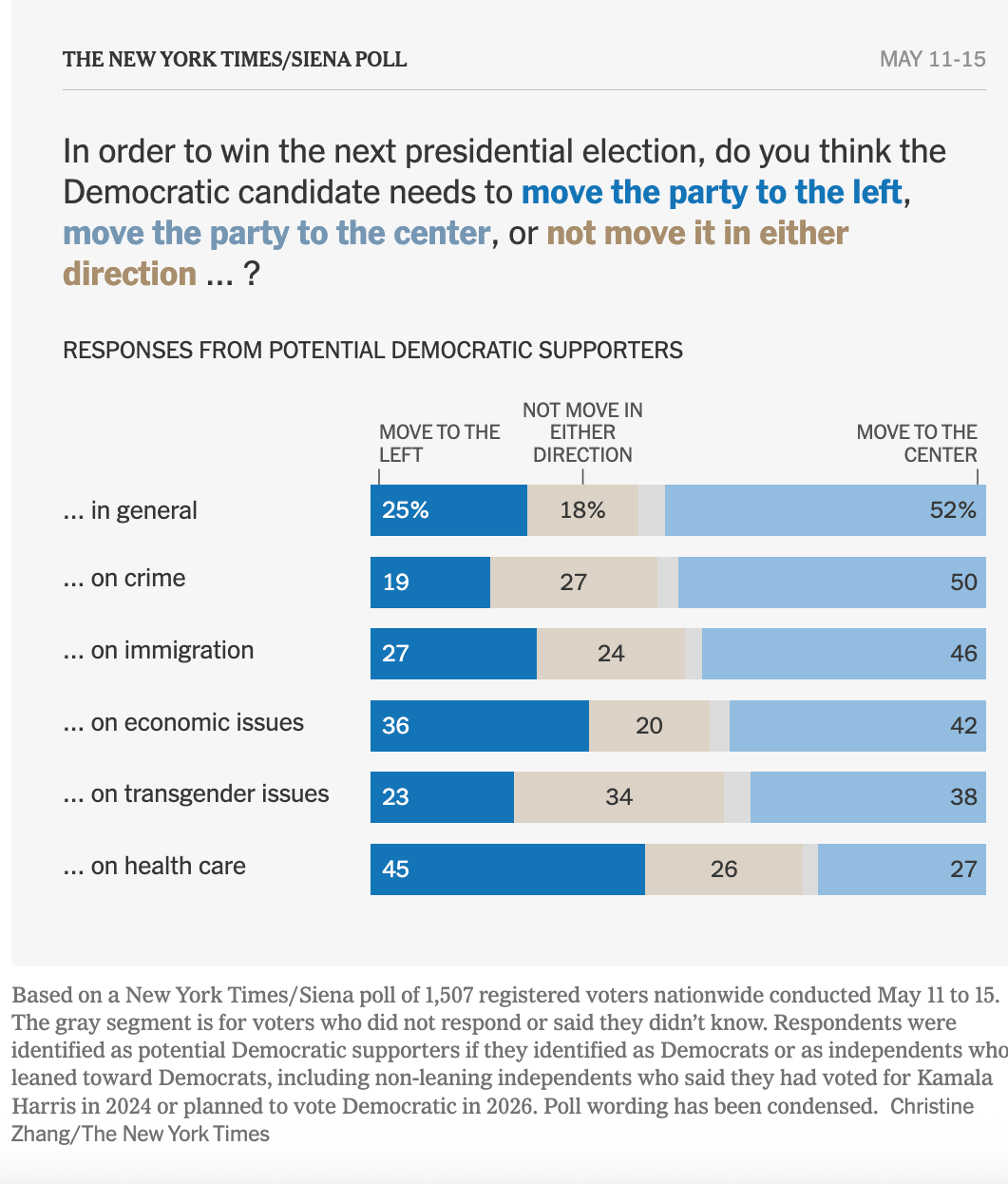
The number of Democrats who think the party should move to the center is slightly smaller than the number who think doing so would help it win. In other words, there’s a swath of voters willing to swallow their own policy preferences for what they believe will help the party win.
4. Voters Want Populism
Make no mistake — Democrats wanting the party to move to the center is not the same thing as Democrats wanting mealy-mouthed, sand-down-the-edges corporate centrism. Far from it.
Democrats, like the rest of the electorate, think the system is corrupt, broken, and unfair, and they’re looking for people with the willingness and the strength to overturn it. Nearly nine in ten respondents think the country’s economic system is unfair to most Americans. More than eight in ten think the political and economic system either needs to be torn down completely or undergo major changes.
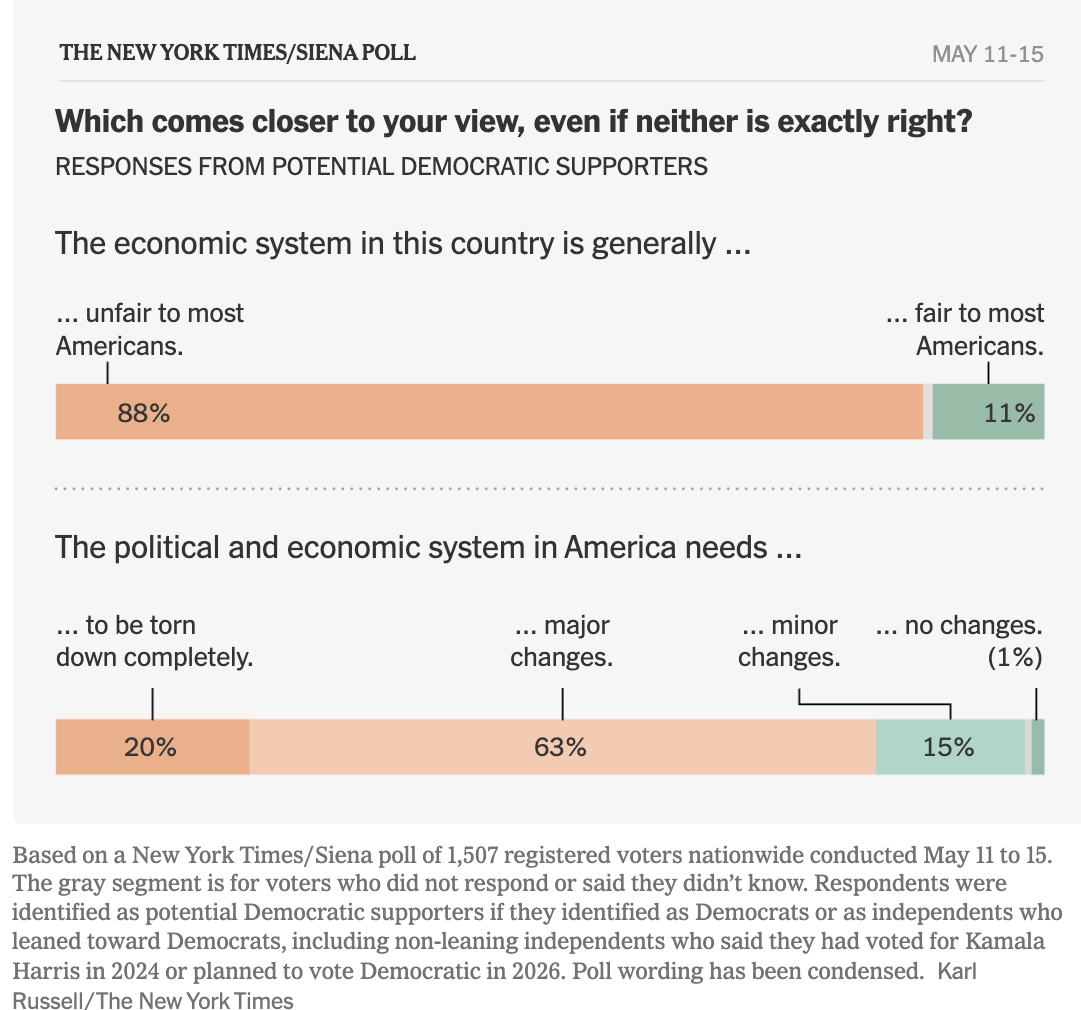
The party also prefers a candidate “who promises to lower prices by going after corporate monopolies and price gouging” over one who promises to lower prices by making it easier to build housing and expand energy production — by 37 points. You can also see the desire for populism in the fact that 50% of the sample wants Democrats to move to the left on health care.
I know these results are frustrating and confusing. But voters can be frustrating and confusing. They look at the world differently than political professionals do, and they tend to reject ideological silos.
Perhaps the most important finding from this poll is that there’s an assumption baked into much of Democratic strategy: that there’s an inherent tension between appealing to the base and appealing to swing voters — that appeals to one group necessarily alienate the other. This poll, very helpfully, shows that’s not really the case.
What exactly is “center” now? And, I truly love what Senator Raphael Warnock always says: it’s not about left and right, it’s about right and wrong. My undergrads are also so simply sick of the lack of morality and the control as you mention by corporate America. Pretty f ing scary all of what is to come. My students give me hope tho.
I wonder how many of those poll respondents realize that shifting the economy to benefit more Americans and regulating unfair practices by corporations are left wing positions? You describe it as populism, but it's populism that drives things leftward. If populism alone was a big enough driver, I don't know why these respondents wouldn't be satisfied with the current president, the single best populist messenger of the century thus far. If it's because they don't like the substantive part of his platform (jailing minorities, criminalizing abortion, or giving tax breaks to everyone in his bracket), then that's an ideological difference. If you have a raucous, pro people campaign with the intention of governing like Schumer, you're a liar. They can't message like a populist without the ideology behind it without becoming inauthentic